

China is developing, a major competitor in the world for its industries, economy and higher education. The country is very affordable, the cost of living and tuition fees are much lower on average compared to other countries. The Chinese government is investing excessively in education to get more international recognition. Thus, you will get a chance to get the top education at an average price you can afford. Moreover, many students worldwide choose to study in China for a chance to meet people from all over the world and expand their network! As the second-largest economy in the world, just one step down from the United States, only would work there be immensely rewarding, but studying in China would be so as well. Just note that costs and exchange rates are appropriate at the time of publication. Some costs have been rounded up or down.
Application processing fees for different majors for different degrees in every university vary from 200 USD to 400 USD. Among all the programs offered by universities, MBBS may be the most expensive one regarding application fees. Besides, the higher rank of China’s Universities List is the more expensive of the application fee will be. However, the tuition fee of Chinese universities is quite low compared with that of the UK/USA. The estimated tuition fee ranges from 3300 USD (around 20,000 RMB) to 9900 USD (around 60,000 RMB) per year. Winning a scholarship to study in China can give you a tuition fee waiver, free accommodation, and even a monthly stipend to bear food and other costs to study in China as an international student.
Partial, full, and fully funded scholarship options are available.
Other essential costs for study
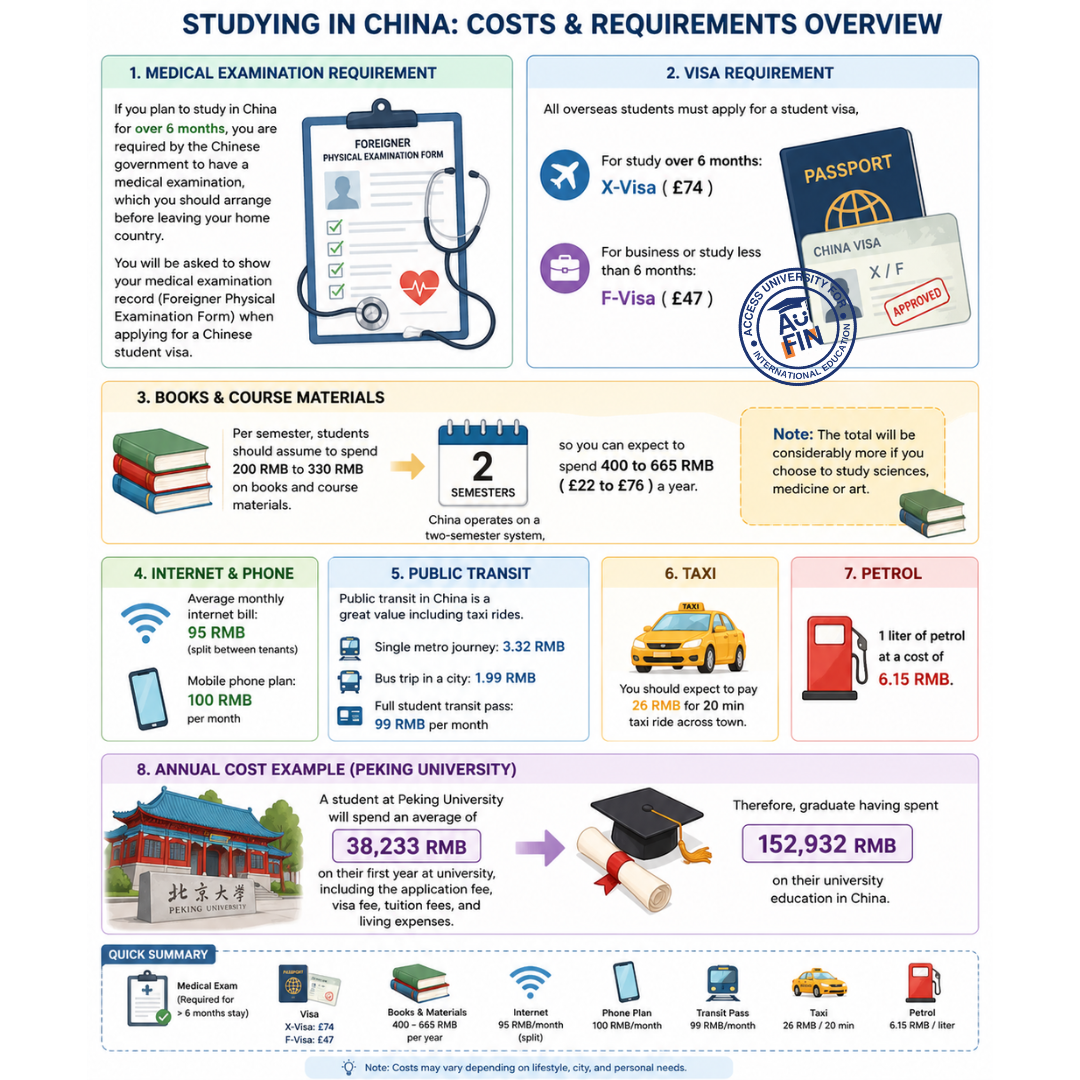
If you have the plan to study in China for over 6 months, you are required by the Chinese government to have a medical examination, which you should arrange before leaving your home country. You will be asked to show your medical examination record (Foreigner Physical Examination Form) when applying for a Chinese student visa.
All overseas students must apply for a student visa, either your goal is to stay for more than 6 months (X-Visa £74), or a business visa or if you are planning to stay for less than 6 months (F-Visa, £47). Per semester, students should assume to spend 200 RMB to 330 RMB on books and course materials. China operates on a two-semester system, so you can expect to spend 400 to 665 RMB(£22 to £76) a year. So the total will be considerably more if you choose to study sciences, medicine or art. The average monthly internet bill is 95 RMB(split between tenants) and a mobile phone plan is 100 RMB a month.
Public transit in China is a great value including taxi rides. A single metro journey price is 3.32 RMB, a bus trip in a city is 1.99 yuan, while a full student transit pass costs are 99 RMB per month. You should expect to pay 26 RMB for 20 min taxi ride across town. 1 liter of petrol at a cost of 6.15 RMB. For example, a student at Peking University will spend an average of 38,233 RMB on their first year at university, including the application fee, visa fee, tuition fees, and living expenses. Therefore, graduate having spent 152,932 RMB on their university education in China.
Accommodation Cost
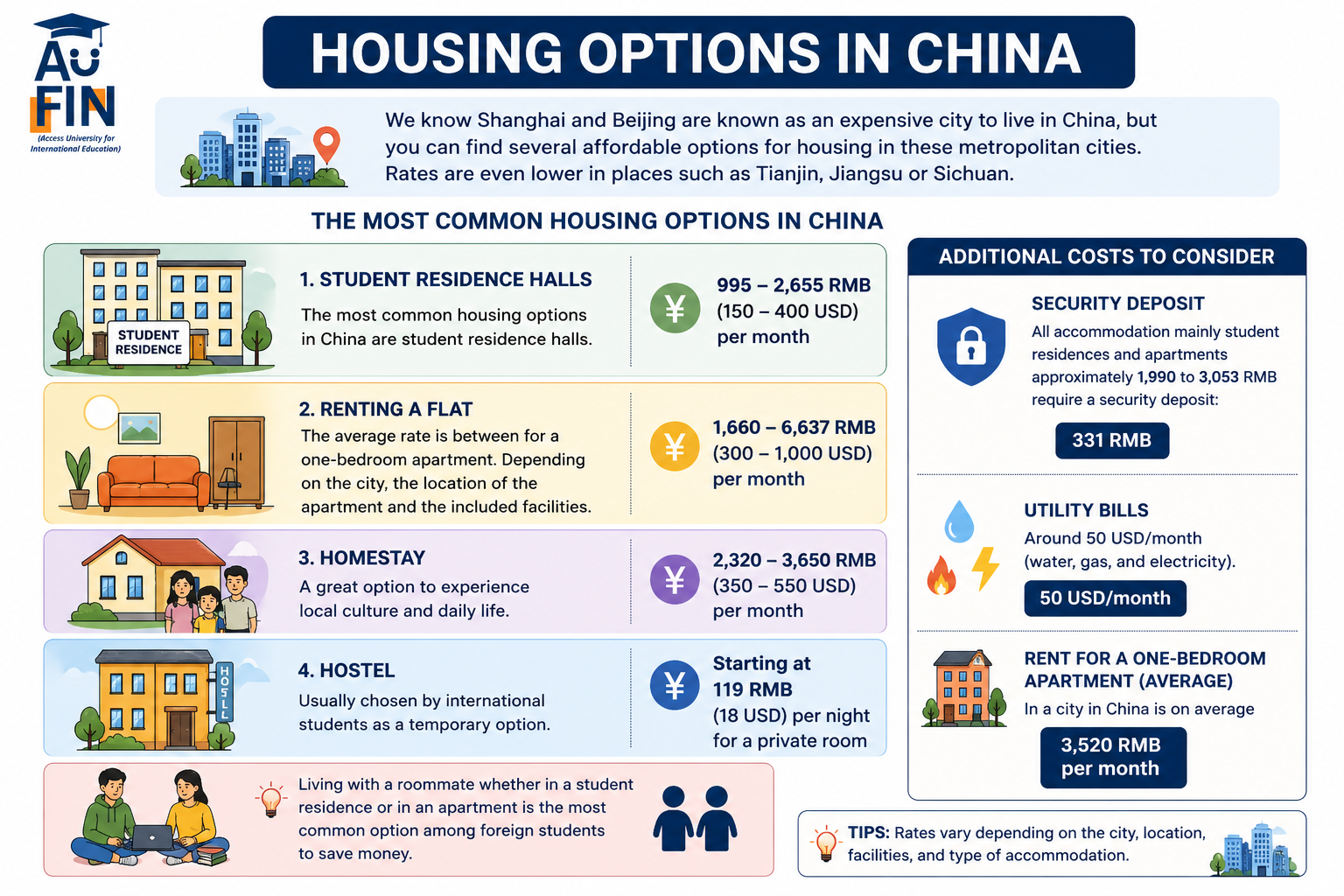
We know Shanghai and Beijing are known as an expensive city to live in China, but you can find several affordable options for housing in these metropolitan cities. Rates are even lower in places such as Tianjin, Jiangsu or Sichuan. The most common housing options in China are:
- Student residence halls –The most common housing options in China are student residence halls (995 RMB to 2,655 RMB, or 150 USD to 400 USD/ month)
- Renting a flat – the average rate is between (1,660 RMB to 6,637 RMB or 300 USD to 1,000 USD/month) for a one-bedroom apartment. Depending on the city, the location of the apartment and the included facilities.
- Homestay– between 2,320 RMB to 3,650 RMB or 350 USD to 550 USD/month.
- Hostel – usually chosen by international students as a temporary option; rates start at 119 RMB or 18 USD/night for a private room.
Living with a roommate whether in a student residence or in an apartment is the most common option among foreign students to save money.
- All accommodation mainly student residences and apartments approximately 1,990 to 3,053 RMB require a security deposit: 331 RMB.
- Utility bills: around 50 USD/month (water, gas, and electricity). Rent for a one-bedroom apartment in a city in China is on average 3,520 RMB per month.
The Cost of Living in China
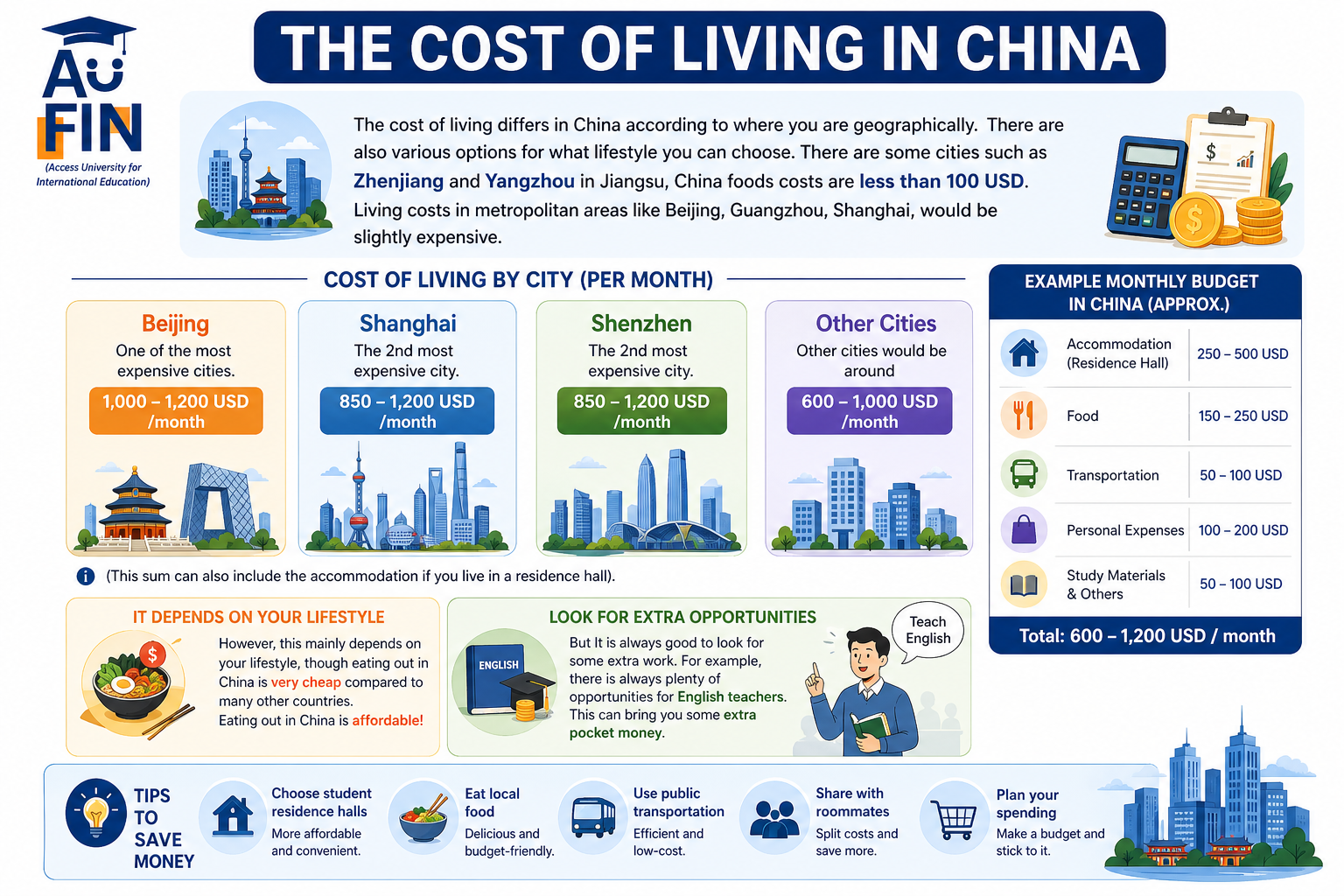
The cost of living differs in China according to where you are geographically. There are also various options for what lifestyle you can choose. There are some cities such as Zhenjiang and Yangzhou in Jiangsu, China foods costs are less than 100 USD. Living costs in metropolitan areas like Beijing, Guangzhou, Shanghai, would be slightly expensive. For example, Beijing is one of the most expensive city and you will need between 1,000 and 1,200 USD/month to cover your expenses. Shanghai and Shenzhen are the 2nd most expensive cities, as you would spend between 850 and 1,200 USD/month. Other cities would be around 600 USD-1000 USD/ month (This sum can also include the accommodation if you live in a residence hall).
However, this mainly depends on your lifestyle, though eating out in China is very cheap compared to many other countries. But It is always good to look for some extra work. For example, there is always plenty of opportunities for English teachers. This can bring you some extra pocket money.
Food Costs
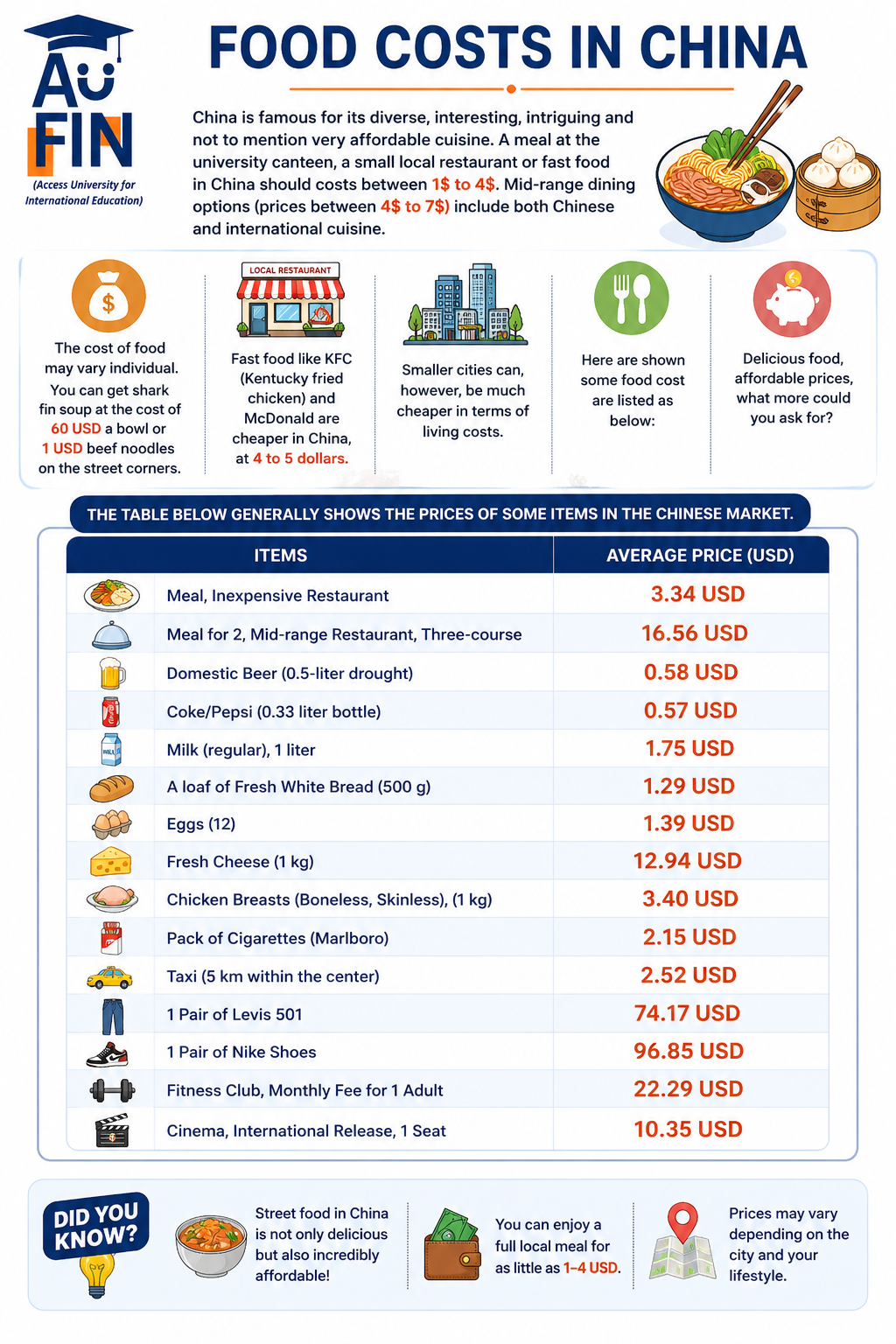
China is famous for its diverse, interesting, intriguing and not to mention very affordable cuisine. A meal at the university canteen, a small local restaurant or fast food in China should costs between 1$ to 4$. Mid-range dining options (prices between 4$ to 7$) include both Chinese and international cuisine. The cost of food may very individual. You can get shark fin soup at the cost of 60 USD a bowl or 1 USD beef noodles on the street corners. Fast food like KFC (Kentucky fried chicken) and McDonald are cheaper in China, at 4 to 5 dollars. Smaller cities can, however, be much cheaper in terms of living costs. Here are shown some food cost are listed as below:
The table below generally shows the prices of some items in the Chinese market.
| Items | Average Price |
| Meal, Inexpensive Restaurant | 3.34 USD |
| Meal for 2, Mid-range Restaurant, Three-course | 16.56 USD |
| Domestic Beer (0.5-liter drought) | 0.58 USD |
| Coke/Pepsi (0.33 liter bottle) | 0.57 USD |
| Milk (regular), 1 liter | 1.75 USD |
| A loaf of Fresh White Bread (500 g) | 1.29 USD |
| Eggs (12) | 1.39 USD |
| Fresh Cheese (1 kg) | 12.94 USD |
| Chicken Breasts (Boneless, Skinless), (1 kg) | 3.40 USD |
| Pack of Cigarettes (Marlboro) | 2.15 USD |
| Taxi (5 km within the center) | 2.52 USD |
| 1 Pair of Levis 501 | 74.17 USD |
| 1 Pair of Nike Shoes | 96.85 USD |
| Fitness Club, Monthly Fee for 1 Adult | 22.29 USD |
| Cinema, International Release, 1 Seat | 10.35 USD |
Please contact scholars@aufin.org if you require further assistance.
